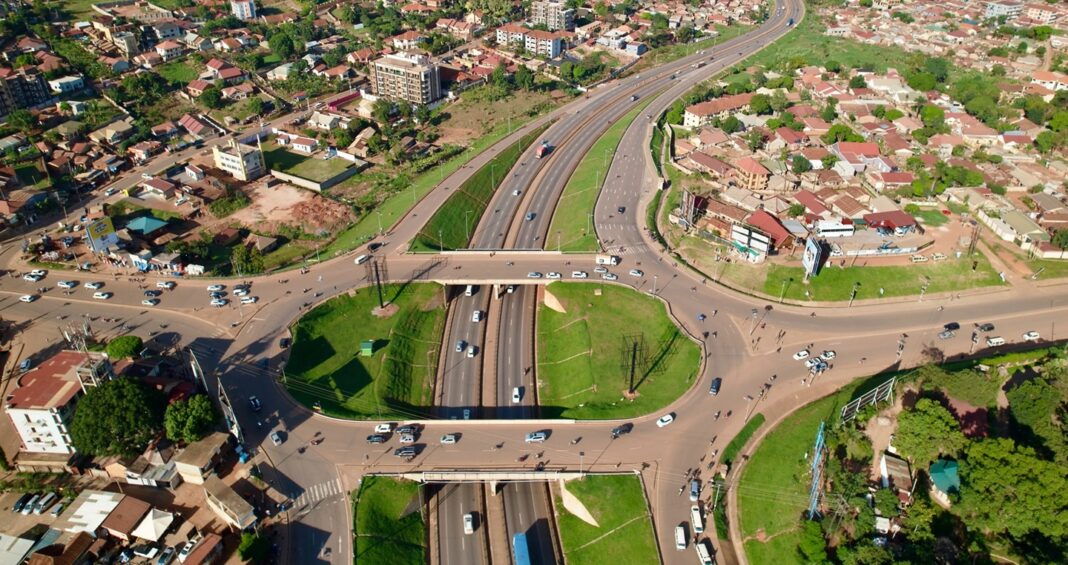
Italian construction company Salini Constructori SpA has lost its attempt to recover about UGX19.47 billion from the Government of Uganda over the construction of the Kampala Northern Bypass, after the High Court found that the amounts claimed had already been paid, determined through arbitration or released under an earlier settlement.
Commercial Court Judge dismissed Salini’s case with costs to the Attorney General, bringing another chapter in a dispute that has its origins more than two decades ago.
Salini’s claim comprised approximately UGX9.47 billion and €2.23 million. At the prevailing conversion used in the reporting of the case, the euro component was worth roughly UGX10 billion, putting the combined claim at about UGX19.47 billion.
The court’s conclusion was that the 2015 settlement between Salini and Government preserved the process of preparing a final account, but did not give Salini a fresh opportunity to reopen financial claims that had already been resolved.
Justice Mubiru ultimately described the plaintiff’s claim as being without merit.
The dispute goes back to the beginning of the Kampala Northern Bypass project.
In April 2003, Salini signed a contract with the Government of Uganda for construction of the bypass. The original contract was valued at approximately UGX98.17 billion, inclusive of VAT, and was financed by the European Development Fund.
The contract value was subsequently adjusted to approximately UGX83.90 billion excluding VAT following changes to Uganda’s VAT legislation.
Construction began in May 2004. The works were originally scheduled for completion by November 2006, but the completion date was subsequently extended to April 2008.
The project took longer than originally anticipated. The works were eventually completed in September 2009, while the Final Acceptance Certificate was issued on 19 June 2015.
By then, however, the contractual relationship had already generated a series of disputes between Salini and Government.
Some of those disputes went through the contractual dispute-resolution process and eventually reached arbitration.
One of the most significant was what became known as the Asphalt Claim.
Salini sought approximately UGX60 billion in additional compensation, arguing that increased requirements for asphalt had imposed costs that could not reasonably be absorbed under the original contract.
The dispute went to arbitration, and in March 2013 the arbitral tribunal found that both Salini and Government had contributed to delays on the project.
But the tribunal also found that Salini had unjustifiably suspended the works. As a result, it did not award Salini additional payment or damages in relation to the claim.
The tribunal did, however, grant Salini a retrospective extension of time, moving the contractual completion period to 1 October 2009. That extension protected the contractor from liability for liquidated damages, although it did not result in an additional financial award.
Other disputes were dealt with through a joint measurement exercise.
That process eventually produced Interim Payment Certificate No. 67, valued at approximately UGX3.05 billion and €2.98 million.
The certificate covered a number of disputed matters and was subsequently fully paid by Government by February 2012.
Despite the various claims having been addressed through arbitration, payment and other contractual mechanisms, the parties later sought a more formal conclusion to their relationship.
On 2 June 2015, Salini and Government entered into a Deed of Settlement and Release.
The agreement became one of the most important documents in the later court proceedings.
One provision, Clause 3, preserved the process for determining the final payment. Salini was required to prepare and submit a draft final statement of account.
Another provision, Clause 4, contained a broad release of rights and obligations arising from the contract.
The distinction between those two provisions eventually became central to the case.
On 17 August 2015, Salini submitted its draft final account.
It claimed approximately UGX9.47 billion and €2.23 million from Government.
The Government rejected the account in March 2016, maintaining that the claims contained in it had already been dealt with through previous payments, arbitration and the settlement agreement.
Government asked Salini to submit a further draft final account showing a nil balance.
Salini did not accept that position.
Instead, the company commenced proceedings in December 2016, arguing that Government had failed to complete the final-account process and that money remained outstanding.
The case therefore presented the court with an important distinction.
Did preserving the procedure for preparing the final account mean that Salini was entitled to have its financial claims reconsidered?
Or did the settlement preserve only the process of closing the account, while leaving claims that had already been settled outside the scope of that process?
Justice Mubiru agreed with Salini on part of the argument.
The judge found that the 2015 settlement had indeed preserved the final-payment process, meaning that Salini was entitled to pursue the issue of the final account.
But that did not establish that Government owed Salini the money claimed.
The court then examined the individual components of the claim.
Several of the amounts claimed had already been dealt with under Interim Payment Certificate No. 67. These included claims relating to traffic management, excavation, reinforced earth works and revisions to manpower and diesel prices.
The court also considered claims that had already been addressed through arbitration or otherwise determined under the contractual process.
A claim concerning defective bituminous surfacing had been dealt with through arbitration. Another claim concerning allegedly under-certified earthworks had previously been determined and was reflected in the payment arrangements associated with Interim Payment Certificate No. 67.
The effect was that the court could not treat those matters as fresh debts simply because they had been included in a later draft final account.
Salini also claimed approximately UGX4.74 billion and €145,923 in interest.
That claim failed for a straightforward reason.
Interest, the court reasoned, cannot exist independently of the underlying debt. If there is no outstanding principal amount on which interest can accrue, there can be no separate claim for interest on that amount.
The court therefore rejected the interest component as well.
The result was significant.
Although the 2015 settlement preserved the procedure for preparing a final account, the court found that the process did not reopen claims that had already been settled through payment, arbitration or the settlement itself.
The final account therefore amounted to a nil balance.
The court also rejected Salini’s argument that Government’s failure to issue a subsequent Final Statement of Account entitled the contractor to damages. The court found that Salini had itself declined to submit the corrected final account showing a zero balance after Government requested it.
The dispute thus ended with no additional payment to Salini.
For a project that began with a contract worth approximately UGX98.17 billion, involved extensions of time, multiple disputes, a UGX60 billion arbitration claim, a UGX3.05 billion and €2.98 million interim payment certificate, a 2015 settlement and a later claim of approximately UGX19.47 billion, the eventual answer from the court was that there was nothing further to pay.
The case is a reminder to the construction industry that a final account is not necessarily an opportunity to reopen every financial disagreement that arose during a project. Where claims have already been paid, determined through arbitration or released through settlement, a later final-account exercise may simply be the process of formally recording that position.
For contractors, employers, consultants and other professionals involved in major infrastructure projects, the case also underlines the importance of carefully documenting claims, payments, dispute determinations and settlement agreements as a project moves toward close-out. The physical completion of a project may be visible to everyone, but determining what remains contractually payable can take years—and the final answer may depend on documents and decisions made long before the final account is prepared.
This article is an industry report based on the court proceedings and is not legal advice.
Case: Salini Constructori SpA v Attorney General and Another, Civil Suit No. 979 of 2016, High Court of Uganda, Commercial Division, judgment delivered on 30 September 2026.